Composting
According to the U.S. Environmental Protection Agency (EPA), composting is the controlled biological decomposition of organic material in the presence of air to form a compost. Controlled methods of composting include mechanical mixing and aeration, ventilation of the materials by lowering them through a vertical series of aerated chambers, placing the compost in piles, or placing the compost in piles in the open air and periodically mixing or turning it.
Composting Process
Composting is nature’s way of recycling (EPA). It is nature’s method for recycling leaves, grass clippings, kitchen remnants, and other organic wastes by transforming them into compost, a valuable soil amendment. Successful composting requires four things: I) Organic matter, such as leaves, grass clippings, garden plants, kitchen scraps and shredded paper. II) Soil micro-organisms, such as bacteria, fungi and other decomposers which break down the organic materials III) Water IV) Oxygen. Maintaining the temperature of the composting materials is important to make the composting process work.
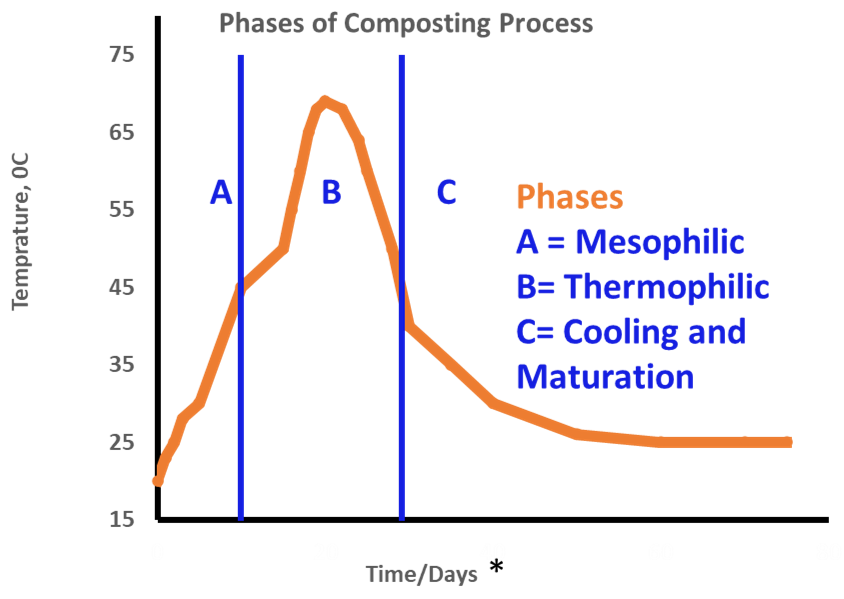
Degradation of the waste materials in compost proceeds through three major phases: Mesophilic phase, thermophilic phase and cooling and maturation phase (Figure 1). A composting phase that takes place between a temperature range of ~ 20 °C and 45 °C is called Mesophilic phase. This is the phase at which mesophilic bacteria and fungi easily degrade compounds of organic matter, consisting of monosaccharides, starch, and lipids. Thermophilic phase is the phase that occurs between ~ 45 °C and 75 °C in the composting process; this process is accomplished by specific colonies of microorganisms that perform waste decomposition at a higher rate. This phase can last from few days to several months. An increase in temperature decreases microbial activity and diversity. The last phase is cooling and maturation phase, where the mesophilic bacteria and fungi reappear, and the process will slowly continue as the compost humifies and matures (Rudnik, E. 2019).
The process of composting of organic materials by microorganisms can be written as:
Organic materials + microorganisms+O2(air)→ H2O+ CO2+ compost+ heat
Composting Methods
Composting can be done at a large scale, known as industrial/commercial composting, or at a small scale, called home composting. The two common industrial composting methods are aerated static pile method and windrow method. Home composting can be done through different methods. Among common home composting methods are Trench composting, Pile composting, Tumbler composting, Bin composting and Vermicomposting (EPA).
Compostability of Materials and Composting Standards
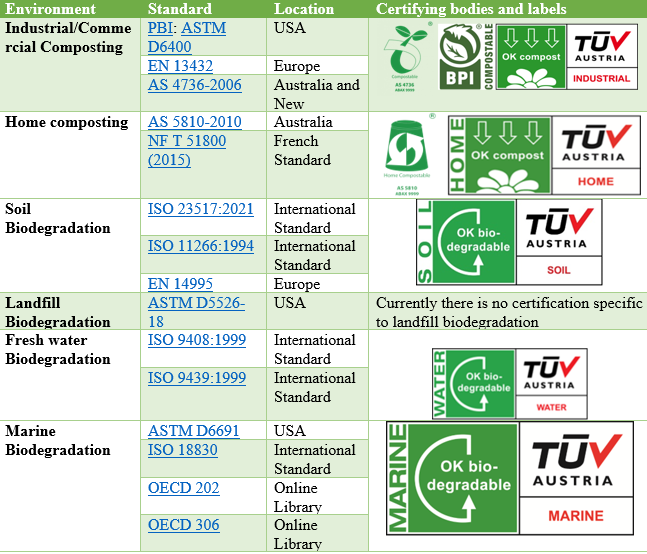
Compostable materials are materials that decompose in composting conditions (either industrial or home composting conditions) generating non-toxic components (water, carbon dioxide, and biomass) that will not harm the environment and passes compostabilty standards. Table 1 summarizes compostability and biodegradation (under different environment) standards and certifying bodies.