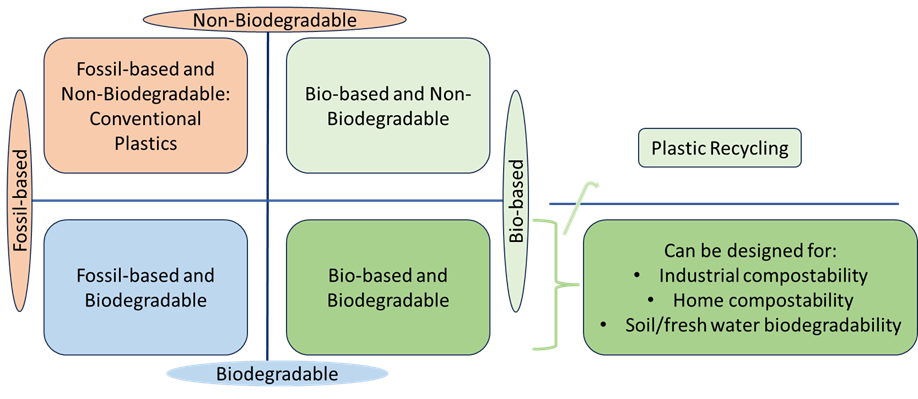
Bio-based plastics are derived fully or partially from biological sources, as opposed to conventional plastics which are made from fossil fuels such as oil. Plastic can degrade into small pieces and invisible powders without involvement of micro-organisms. Plastic can also biodegrade but is not compostable; that is, the biodegradation rate of the material may be insufficient to meet the criteria for being classified as compostable (Stevens, E.S. 2002). Therefore, the difference between biodegradation and compostability is that in addition to biodegradation to yield CO2, H2O, inorganic compounds, and biomass; compostable plastics should fulfill additional criteria (Rudnik, E. 2019).
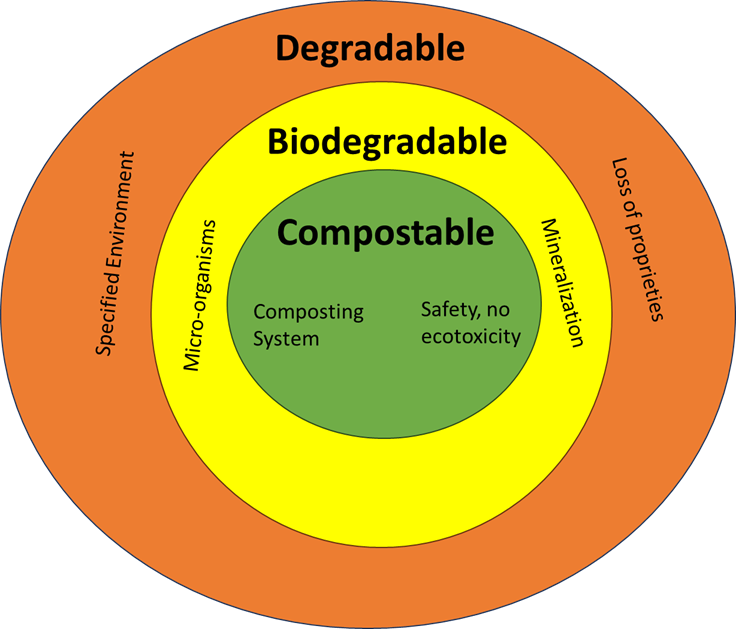
Compostable material should 1) undergo mineralization (biodegradation to carbon dioxide, water and biomass), 2) disintegrate in a composting system, 3) complete its biodegradation during the end-use of the compost, and 4) passes quality criteria, example, no ecotoxicity. Figure 1 summarizes the concepts of degradation, biodegradation, and compostability. Figure 2 shows the relationship between fossil-based, bio-based, bio-degradable, and compostable plastics.