Traditional paper-based labels are currently viewed, by the Association of Plastics Recyclers (APR), as detrimental in the PET recycling stream. However, SmartSolve water-soluble paper labels passed APR Design Recognition in May of 2024, causing a bit of a stir in the industry. SmartSolve’s 4PT Direct Thermal Pressure Sensitive dissolvable label and 3PT (thermal transfer capable) Pressure Sensitive dissolvable label met the highest criteria for recyclability. Both labels were evaluated using the most stringent, industry accepted criteria that encompass a wide range of design features affecting plastic recycling. With 20% label coverage, both products passed PET-CG-02 .
The Association of Plastic Recyclers (APR) has consistently highlighted that regular paper-based labels are problematic in the PET recycling stream. But what are the attributed problems with regular paper-based labels and how are SmartSolve labels different?
What Are the Problems with “regular” Paper-Based Labels When It Comes to PET Recycling?
According to the APR, typical paper-based labels (non-water-soluble labels) are considered detrimental to the PET recycling stream for several reasons.
However, SmartSolve’s materials pose an interesting exception to the norm:
Contamination from Paper Fibers
During the washing process, standard paper labels break down and release fibers into the recycling stream, contaminating the PET material. These fibers can be difficult to remove and may negatively impact the quality of recycled PET (rPET).
SmartSolve Paper Fibers
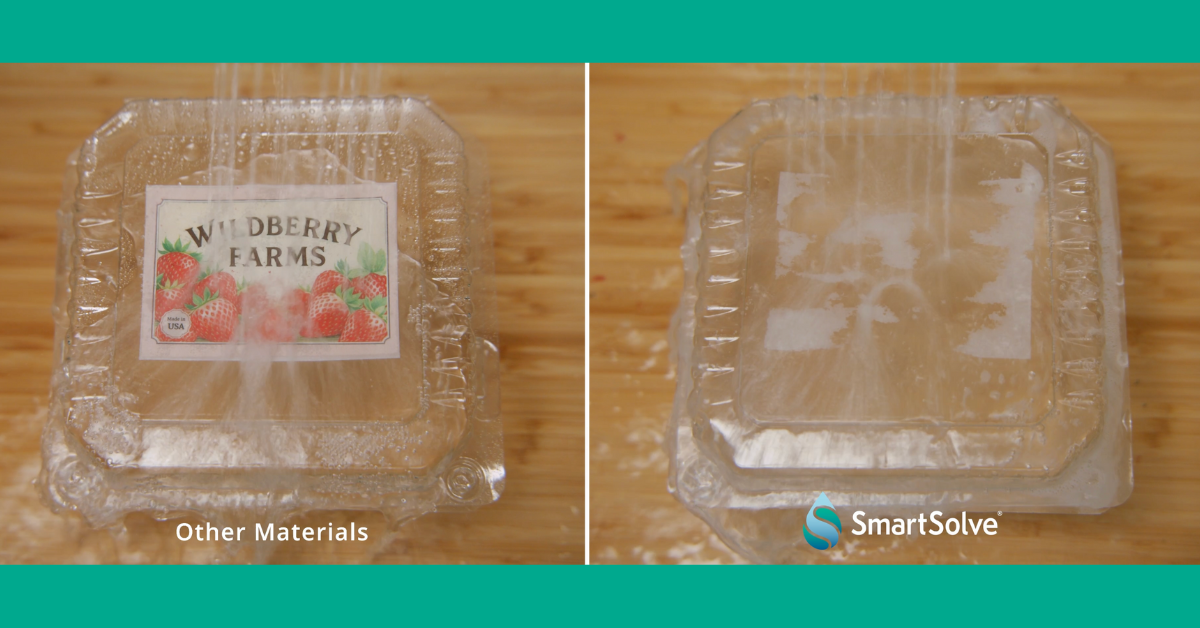
SmartSolve water-soluble paper completely disperses, allowing wood pulp fibers to cleanly separate from the plastic flake and can be easily filtered out just like, per APR guidance.
Adhesive Residue Issues
Many paper labels use adhesives that do not fully dissolve or separate cleanly from PET during processing. These residues can stick to PET flakes, causing processing inefficiencies and lowering the quality of recycled PET (rPET).
SmartSolve Adhesive
SmartSolve’s water-soluble adhesive completely dissolves in water, allowing an easy separation from PET flakes in water, without additional chemicals and excessive washing, creating a clean and pure PET flake.
Ink Bleeding and Staining
Paper labels often contain inks that can bleed during the washing stage, staining PET flakes and reducing their clarity, which is critical for high-quality recycling applications.
SmartSolve Ink Solution
SmartSolve has partnered with Siegwerk to leverage an inking system that is already APR Recognized. This particular inking system uses UV Cured inks and an aqueous coating which allows the ink to liberate from the paper and be collected, just as other polyolefin labels would also be collected.
Separation Challenges
Unlike plastic labels, which can often be designed to float and separate from PET in a sink/float process, paper labels can break apart and mix with the PET, making it harder to achieve pure PET recycling streams.
SmartSolve Response to Separation Challenges
Through a joint collaboration with Siegwerk, (an international manufacturer of printing inks and coatings), a print trial was conducted and the labels were applied to PET. Using current APR guidance, the ink liberations were caught in the siv, the wash water remained unchanged, and the label completely removed from the PET flake during the wash process. A clean flake was reported during our initial testing.
Why Go Through All the Hassle for Innovation? What Is the Value?
Innovation has always been the “crazy person in the room”. Henry Ford is famously quoted with having said, “If I had asked people what they wanted, they would have said faster horses.” The quote reflects the idea that true innovation often comes from envisioning something entirely new rather than just improving existing solutions.
Ford’s development of the assembly line and the Model T revolutionized transportation in a way that people might not have imagined themselves or felt possible. We believe we are doing something similar with plastics recycling. We’ve imagined a new way that can help to improve the recyclability of hard-to-recycle PET plastics, like thermoforms. We’re adding optionality to your label materials selection when it comes to plastics recycling.
A Return of the Aesthetic of Paper Labels
SmartSolve is pioneering a new way for brands to leverage paper labels on their PET products. Brands have long favored the aesthetic of paper labels; they evoke a sense of authenticity, craftsmanship, and a high-end appeal. However, with advancements in recycling, brands have been told paper labels are bad for the recycling stream and are difficult to separate from the PET flake after the grinding process. SmartSolve’s paper-based water-soluble labels, act differently in the recycling process which avoid the concerns set out by APR while also offering brands the aesthetic they desire for their products. With SmartSolve, you can have the best of both worlds – you can have your proverbial cake and eat it too.
Offering an Experience and Inviting Consumer Participation for Recycling
SmartSolve labels look very much different than the polyolefin label incumbents. The consumer will take note of this difference, and with on-pack claims about performance, consumers can even be invited to play an active part in recycling by washing off the material themselves, if they so desire. By selecting products with SmartSolve paper-based labels, consumers can feel assured they are contributing to less products ending up in landfills.
And here’s the kicker, even the polyolefin labels are not actually recycled, they are separated from the PET flake and end up as a sludge at the end of the process, which is ultimately taken to landfill. SmartSolve labels disperse in water (without all the chemicals and caustic conditions), go through the filter during the wash process and down the drain and are processed further at local sewage stations. And here’s another fun fact – this same activity has been happening for over 30-years in the back of restaurant kitchens with water-soluble food rotation labels.
Regulatory Landscape and EPR
As Extended Producer Responsibility (EPR) legislation gains momentum across global markets, brands are under increasing pressure to ensure their packaging materials align with stricter recycling and sustainability requirements. EPR laws place the financial and operational responsibility of post-consumer packaging waste on manufacturers, incentivizing them to design for recyclability and reduce environmental impact. In regions like the European Union, Canada, and several U.S. states—including California and Maine—new policies are driving brands to rethink material choices, pushing for solutions that minimize contamination and enhance the efficiency of recycling streams. California SB 343 and SB 54 use APR guidance as a definition of what is broadly considered a recyclable material.
SmartSolve’s water-soluble labels provide a proactive response to these evolving regulations. By eliminating contamination risks in PET recycling, our materials support the circular economy goals outlined in EPR policies. Unlike labels that are considered detrimental to recycling, SmartSolve’s dissolvable solutions seamlessly separate from PET flakes in standard wash processes, ensuring a cleaner, higher-quality recycled material. Brands implementing SmartSolve’s solutions can strengthen their sustainability claims, improve compliance with emerging EPR frameworks, and ultimately enhance their bottom line by mitigating penalties and increasing access to premium recycled content.
SmartSolve: Your Future-Ready Partner in Sustainable Packaging
The future of PET recycling and sustainable packaging is evolving rapidly, with new regulations, shifting consumer expectations, and advancements in material science reshaping the industry. While uncertainty remains, one thing is clear—brands that fail to adapt risk falling behind. As EPR policies tighten and recyclability standards become more stringent, brands must proactively rethink their packaging choices to stay competitive and compliant.
Here at SmartSolve, we take pride in being at the forefront of this transformation, offering water-soluble labels that not only enhance recyclability but also future-ready packaging strategies. By partnering with SmartSolve, you can confidently navigate these changes, ensuring they lead the charge toward a more sustainable future rather than scrambling to catch up.

Marketing Manager