
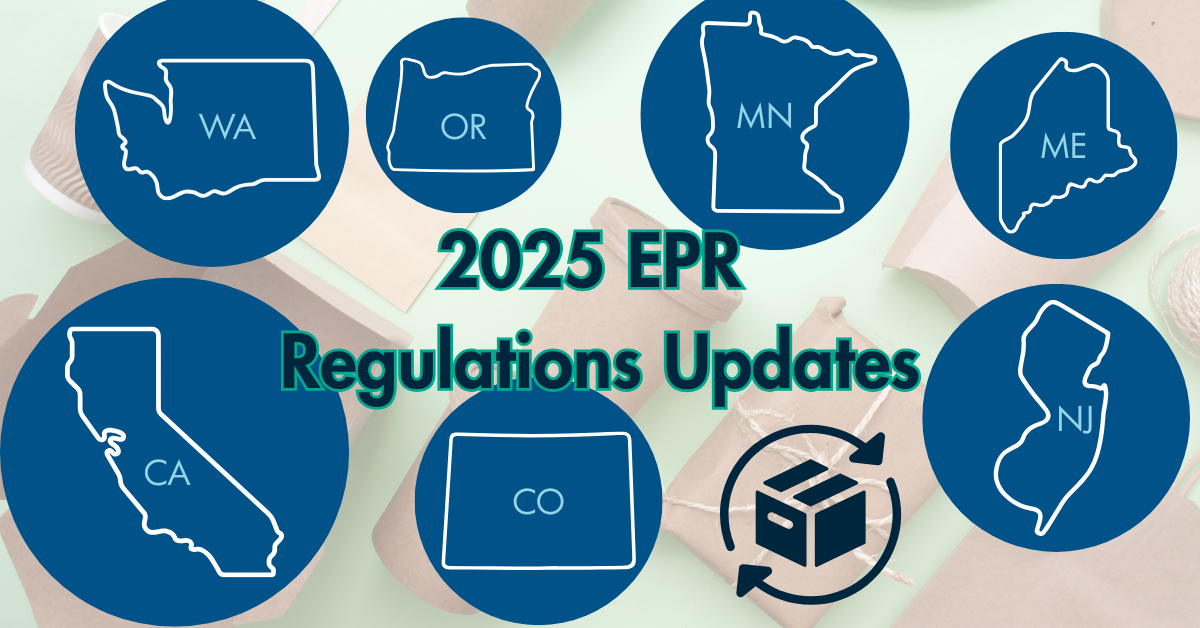
As packaging waste continues to grow and global supply chains are scrutinized for sustainability, staying ahead of Extended Producer Responsibility (EPR) regulations is a business imperative.
In 2025, packaging leaders across industries are expected to meet a new era of accountability, with laws in several U.S. states (and around the world) already in motion. For packaging leaders, understanding EPR regulations is key to building packaging portfolios that not only meet environmental goals but also remain compliant in evolving markets.
This blog offers an up-to-date breakdown of EPR packaging laws by state, explores what brands need to know about reporting, design, and compliance timelines, and offers practical steps to prepare for what’s ahead.
What Is Extended Producer Responsibility (EPR) in Packaging?
EPR refers to a policy framework that holds producers accountable for the end-of-life management of packaging materials. In essence, the responsibility for collection, sorting, recycling, and disposal shifts from local governments to the companies that produce the packaging in the first place.
Through this system, producers must typically:
- Join a Producer Responsibility Organization (PRO)
- Report on packaging use, weight, and composition
- Pay fees based on the environmental impact of their packaging materials
Why Keeping Up with EPR Matters Now
Countries like Canada and members of the EU have had EPR programs in place for years, and now the U.S. is catching up fast. According to the EPA’s National Strategy to Prevent Plastic Pollution, harmonized EPR systems are critical to reducing packaging waste and increasing material recovery.
States like Maine, Oregon, California, Colorado, and Minnesota are actively moving EPR forward, and many more are in early stages of planning. By acting now, brands can avoid the costly consequences of non-compliance and ensure packaging investments are future-ready.
EPR Laws By State: Key Updates for 2025
Maine EPR Law
The rules of Maine’s EPR law – first of its kind nationally when it passed in 2021 – were finalized in December 2024. The law is poised to take effect in 2027. But Maine’s law isn’t without its hurdles: citizens have raised concerns over how Maine’s EPR model will play out in the market, in terms of where the final cost burden falls.
- Status: Passed in 2021; implementation in progress
- Scope: Covers nearly all consumer packaging
- Compliance: Brands will pay fees based on recyclability and environmental impact
Timeline: Rulemaking continues; enforcement expected by 2026
Oregon EPR Law (SB 582)
Oregon’s version of an EPR regulation—Plastic Pollution and Recycling Modernization Act—is comprehensive, with a multi-pillared approach to enhance recycling, waste reduction, and reuse across the state. This includes providing funding to local governments for improvements in Oregon’s recycling services, establishing locations around the state to collect harder-to-recycle items, and reducing environmental impacts of paper, packaging, and food serviceware through fee incentives and by capitalizing a new waste reduction and reuse program among other things.
- Status: Passed in 2021
- Unique Feature: Introduces mandatory labeling accuracy for recyclability claims
- Producer Responsibilities: Join a PRO and report material types, weights, and recyclability
- Timeline: Producer reporting began in 2024; full compliance expected in 2026
Colorado EPR Law (SB 22-180)
Colorado’s EPR regulation—HB 22-1355—sets up a Producer Responsibility program that requires companies that sell products in packaging, paper products to fund a statewide recycling system to recycle those materials.
- Status: Passed in 2022
- Scope: Applies to nearly all packaging and printed paper
- Key Requirement: Producers must register with a single PRO by July 31, 2025
- Timeline: Full system launch in 2026
California SB 54 (Plastic Pollution Prevention and Packaging Producer Responsibility Act)
Submitted in February 2024, the goal of California SB 54 is sweeping: address the impacts of single-use packaging and plastic food service ware. CalRecycles estimates as many as 13,615 producers would be affected by the regulations.
- Status: Passed in 2022; under reevaluation in 2025
- Goals:
- 10% plastic reduction by 2027
- 20% by 2030
- 25% by 2032
- Latest Update: In May 2025, Governor Newsom has paused rulemaking and directed regulators to rework the plan
- Challenges: Clarity on PRO structure and fee calculations still in flux
Minnesota EPR Law
In early 2024, Minnesota’s extended producer responsibility bill—the Packaging Waste and Cost Reduction Act—for packaging, food packaging, and paper products was signed into law. The goal of the act is to reduce environmental and human health impacts of packaging materials through less packaging overall and toxicity reduction, more refillable, reusable, recyclable and compostable packaging, and more curbside collection, among other goals.
- Status: Pending in the 2025 legislative session
- Scope: Would cover packaging and some single-use plastic products
- Forecast Start: If passed, reporting requirements could begin as early as 2027
After January 1, 2032 (if passed), all packaging, food packaging, and paper products must be one of the following:
- refillable and supported by a refill system
- reusable and managed through a reuse system
- recyclable and collected through a curbside or alternative system
- compostable and collected through a curbside or alternative system
New Jersey EPR Law
New Jersey has taken a slightly different route toward Extended Producer Responsibility through recycled content mandates, which are already influencing packaging design across the state. The New Jersey law requires minimum post-consumer recycled (PCR) content in rigid plastic containers, glass, and paper carryout bags.
- Status: Recycled content law passed in 2022; full EPR legislation still under review
- Scope: Currently applies to rigid plastic containers, paper carryout bags, and glass
- Compliance: Companies must meet recycled content targets or face penalties
- Timeline: Current mandates in effect; EPR-specific legislation expected to emerge in 2026 or later
Washington EPR Law (SB 5154)
Washington passed SB 5154 in 2023 to establish a comprehensive EPR framework focused on packaging and paper products. The bill lays out aggressive targets for waste reduction, equity in recycling services, and environmental justice. The Washington Department of Ecology is overseeing the program’s development.
- Status: Passed in 2023
- Scope: Covers packaging, paper products, and some single-use items
- Compliance: Producers must join a PRO, submit detailed packaging data, and pay eco-modulated fees
Timeline: System planning underway; reporting obligations expected to begin by 2026
What These Laws Mean for Packaging Decision Makers
EPR laws aren’t slowing down anytime soon, and their ramifications will fundamentally reshape how brands design, source, and label their packaging.
In the coming months and years, packaging leaders can expect a notable increase in:
- Design-for-recyclability mandates: Incompatible materials (like multi-layer pouches without separation tech) may soon incur higher fees or be banned altogether.
- Reporting requirements: Brands will need systems in place to track and report detailed packaging data by state.
- Fee structures based on impact: Producers using recyclable or compostable materials may receive financial incentives. Others could face escalating costs.
Companies that embrace material innovation, like mono-material packaging or bio-based materials, can reduce compliance risks while achieving sustainability targets.
Stay Ahead of The Shifting EPR Landscape
For U.S.-based packaging teams, EPR is no longer optional. The regulatory landscape is maturing, and forward-thinking brands will view compliance as a launchpad for deeper innovation.
With varying timelines and requirements across states, staying ahead of EPR means staying informed, agile, and – maybe most of all – innovative. Packaging leaders who build flexible portfolios, leverage recyclable and compostable materials, and track legislation in real time will be ready to tackle this new era of EPR.
Interested in learning how SmartSolve can partner with you to enhance packaging sustainability and meet state regulations? Contact us.

Marketing Manager